| |
| |
For many of us in the U.S., it’s clearly November when you watch the sun set—far earlier than it has any business setting—from your desk. Thanks, end of daylight saving time. |
As the days get shorter, getting enough daylight may matter for your health in ways you haven’t considered. My colleague Dominique Mosbergen explored how daylight exposure may even affect your blood sugar. |
Later in this edition, she shares one researcher’s advice about the habit everyone should adopt this time of year. |
|
|
TODAY’S TOPICS |
|
|
|
|
|
| |
|
|
|
| |
| |
INSIGHT OF THE DAY |
Take a cold shower |
 |
boonchai wedmakawand—Getty Images |
|
Most people shudder at the thought of a cold shower. But according to new research by psychotherapist Lena Glaser of the University of Basel, turning the temp of your morning shower down—way down—can have benefits for you and the planet. |
The research, which has not yet been peer-reviewed, included more than 700 healthy adults who did not already take cold showers. People were asked to take a shower at the coldest temperature their plumbing would allow once a day for 12 weeks. By the end, cold-showerers reported feeling more awake and refreshed afterward—and proud of themselves for having taken on something challenging. What’s more, they took 31% fewer sick days from work than people in the control group, who showered as they normally would. |
Using less hot water also conserved energy, which can lower utility bills and carbon emissions. Over the course of the study, the university estimated that participants reduced their carbon dioxide emissions by 33 pounds apiece—about the same greenhouse gas impact as driving more than 60 miles. |
For people interested in trying it, Glaser suggests starting gradually and choosing a temperature that feels tolerable. |
|
|
|
| |
|
|
|
| |
| |
SPONSORED BY THE DEEP VIEW |
Stop Drowning In AI Information Overload |
|
|
Your inbox is flooded with newsletters. Your feed is chaos. Somewhere in that noise are the insights that could transform your work—but who has time to find them? |
The Deep View solves this. We read everything, analyze what matters, and deliver only the intelligence you need. No duplicate stories, no filler content, no wasted time. Just the essential AI developments that impact your industry, explained clearly and concisely. |
Replace hours of scattered reading with five focused minutes. While others scramble to keep up, you'll stay ahead of developments that matter. 600,000+ professionals at top companies have already made this switch. |
Join them today, for free. |
|
|
|
|
| |
|
|
|
| |
| |
WHAT’S GOING AROUND? |
Bird flu in mink |
 |
Konstantin Sokolov—Getty Images |
|
ProPublica first reported an outbreak of bird flu at a mink farm on Oct. 23, saying the virus had been “raging uncontrolled” at the farm for two months. Public-health experts told ProPublica they were surprised that state officials hadn’t ordered the farm to cull the animals, which is what other countries have done when outbreaks have occurred. In 2023, for example, more than 50,000 mink were killed at a farm in Spain after a strain of bird flu was detected at the facility. |
Experts’ concern is that bird flu could mutate in mink to become more dangerous to people. But the risk to the average U.S. person remains, for the moment, low, according to the U.S. Centers for Disease Control and Prevention. |
“The risk is greatest among people who have exposure to sick animals. If that is not you, I think you can take this off your worry list, [but] it does not abdicate the government of its responsibility to try to prevent a pandemic,” Jennifer Nuzzo, director of the pandemic center at Brown University School of Public Health, told the Guardian. |
|
|
|
| |
|
|
|
| |
| |
SPONSORED BY HUBSPOT FOR STARTUPS |
Your GTM Has a Weak Spot. Find It. |
|
|
Your go-to-market feels stuck. Most of the time, nothing is broken. One or two things are just quietly costing you momentum. |
Drop your URL. The free GTM Audit reads your site, pricing, and competitors, scores four dimensions, and hands you a 90-day fix list. |
10 minutes. No guessing. |
Run My Free GTM Audit |
|
|
|
| |
|
|
|
| |
| |
A VIRAL MOMENT |
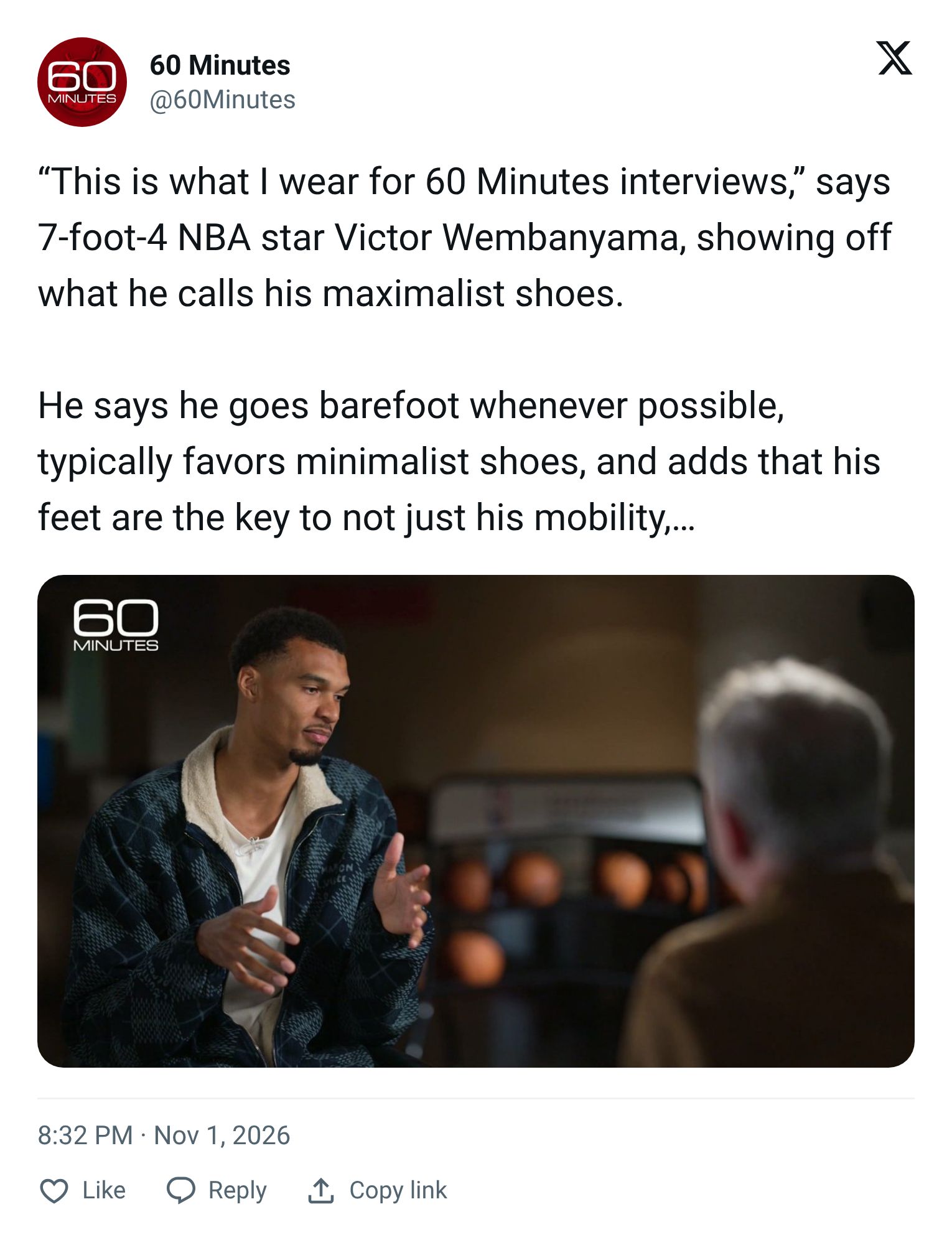
Wemby gives shoes the boot |
NBA player Victor Wembanyama is 7 feet 4 inches tall and wears size 20 shoes. But he prefers to keep them off. In a 60 Minutes interview that aired yesterday, the San Antonio Spurs star said he walks barefoot whenever possible, aiming to strengthen his feet and protect his body. Even correspondent Jon Wertheim’s footwear got a critique: “Those aren’t minimalist, those are maximalist,” Wemby quipped. |
|
|
|
|
|
| |
|
|
|
| |
| |
SPONSORED |
TIME100 Most Influential Companies is expanding |
|
|
TIME100 Most Influential Companies 2027 entries are now open. |
With new Exceptional Workplaces categories, the TIME100 Companies publication is expanding to recognize businesses pioneering new approaches to how people work, from flexible and hybrid work to technology integration and career development. |
Because it’s no longer just what you do, but how you do it. |
Submit your company. |
|
|
|
| |
|
|
|
| |
| |
QUICK CHAT |
The surprising link between sunlight and blood sugar |
My new story out today explores a surprising potential health benefit of daylight: improved metabolism and lower blood sugar. |
Chris Dibben, a health geographer at the University of Edinburgh, has been studying sunlight’s influence on health. He spoke to me recently about his research and why—particularly with winter approaching and evenings darkening earlier—we should go out of our way to soak up the sun. —D.M. |
This interview has been condensed and edited for clarity. |
 |
Ippei Naoi—Getty Images |
|
What prompted you to study the health benefits of daylight? |
About six or so years ago, I became aware of some early research looking at the positive effects of sunlight. That was in stark contrast to the public-health messaging around sunlight that has tended in recent years to focus on the negative aspects, in particular the risk of skin cancer. The studies indicated that we were perhaps missing a story here: that the overall effect of sunlight was actually protective against major diseases. |
What is an example of such a study? |
There was a study in Sweden where they were looking at women who were using tanning beds and sunbathing a lot. The idea was to look at the risk of skin cancer and mortality, but intriguingly, what they found was that although these women had a higher incidence of skin cancer, they actually had better survival than the women who weren't using [tanning] beds or sunbathing. |
A recent paper you co-authored showed a link between sun exposure and reduced blood sugar. Based on your research and other studies on daylight’s benefits, what would you recommend people do? |
The public-health messaging on this is simple. Get outside as much as you can, particularly in the winter. That does mean you probably need to take a break from work and go for a walk. But that is good for you in any case, because exercising moderately has also been shown many times to be one of the most effective health interventions. |
Read the full story here. |
|
|
|
| |
|
|
|
| |
| |
WHAT WE’RE READING |
Sometimes the best therapist has four hooves. The Guardian introduces a miniature horse bringing comfort to psychiatric patients and veterans. Tariffs, high GLP-1 prices, and the increased use of AI are all contributing to rising health care costs, Mary Kekatos writes for ABC News. The world has always been full of things that frighten us. One way we work through these fears is by watching horror, writes Coltan Scrivner for TIME.
|
|
|
|
| |
|
|
|
| |

Click to sign up.
|
|
|
|
|